

Every month, your utility provider sends you a bill based on exactly what your building consumed. Then you turn around and charge your tenants based on square footage. A proper tenant energy billing setup closes that gap, replacing square-footage estimates with real meter data and defensible, auditable invoices. Under a RUBS allocation model, the share of utility cost an owner actually recovers is a function of how well floor area proxies for consumption — and in mixed-use buildings it rarely does. Submetering closes that gap by billing measured kWh instead. Whatever the gap is in your building, it is a recurring loss absorbed quietly, month after month, and it is measurable.
This guide walks through a complete tenant energy billing setup: how to choose the right method, what hardware you need, how to calculate defensible invoices, which software to use, and what the law requires before you flip the switch. This is the framework Emergent Energy Solutions recommends across commercial portfolios to replace square-footage guesswork with metered, verifiable utility cost recovery.
Why square-footage billing is an expensive guessing game
Ratio Utility Billing Systems (RUBS) allocate costs by floor area, occupancy count, or a weighted combination of both. The method is fast to implement and costs almost nothing to set up. The problem is accuracy: RUBS bills a proxy, submetering bills the meter. Every dollar of consumption that the proxy fails to assign to the tenant who caused it is uncovered utility expense the landlord absorbs.
The equity problem compounds the financial one. Tenants running energy-intensive operations effectively get subsidized by lower-usage neighbors under a square-footage system. When high-load tenants pay the same proportional rate as a lightly staffed office down the hall, the conservative users notice, and billing disputes follow. Property managers absorbing uncovered utility costs are often unaware of exactly how large the exposure is, because RUBS never generates the data needed to measure it.
Metered billing does more than recover more dollars. When tenants see a bill tied to their actual consumption, behavior changes. When tenants carry their own metered cost, consumption generally falls, which lowers the total utility bill for everyone. That behavioral effect means the submetering investment pays back in two directions: higher cost recovery today and lower total utility spend going forward.
The consumption data generated by a properly installed submetering system also feeds ESG reporting, carbon accounting, and building performance standard compliance. A RUBS system generates none of that. The billing setup, done correctly, becomes the data infrastructure for the building's entire energy management program, including energy management system (EMS) integration where portfolio-level monitoring is required.
Tenant Energy Billing Setup: Submetering vs. RUBS
Submetering delivers metered, per-tenant kWh data that is accurate, traceable, and legally defensible. Hardware and installation runs $200 to $600 per unit in retrofit settings, with total first-year system costs for multi-tenant buildings over 25,000 square feet typically falling between $6,200 and $29,000 depending on panel configuration and the number of tenant loads. Payback is driven by improved cost recovery and by consumption reductions from tenant accountability; calculate it against your own recovery gap and quoted system cost. These ranges reflect typical retrofit scenarios and will vary by building type, utility type, and regional labor and materials costs.
A well-executed submetering setup is also the only method that generates the audit-ready interval data required for Scope 2 carbon reporting, SBTi compliance, and building performance standards. If your portfolio has ESG commitments or faces regulatory reporting requirements, RUBS cannot support those goals. If panel access and ceiling clearance allow for metering installation, submetering is the right call.
RUBS costs almost nothing to implement and works in older buildings where metering retrofit is physically impractical or cost-prohibitive. For portfolios with limited capital budgets and buildings that genuinely cannot support submeter installation, it remains a better option than absorbing utility costs entirely. The limitations are real: lower recovery rates, no data output for carbon reporting, and outright prohibition in several states including Massachusetts, North Carolina, Mississippi, and Delaware.
Colorado has gone further than a flat prohibition: any new construction with permits filed after July 1, 2027, must use direct metering rather than RUBS. That regulatory trajectory is worth factoring into any long-term capital plan. Always verify current local restrictions before locking in either approach, and in Mid-Atlantic markets specifically, consult your state's Public Utility Commission requirements before proceeding.
Tenant Energy Billing Setup: Hardware and AMI Gateway Selection
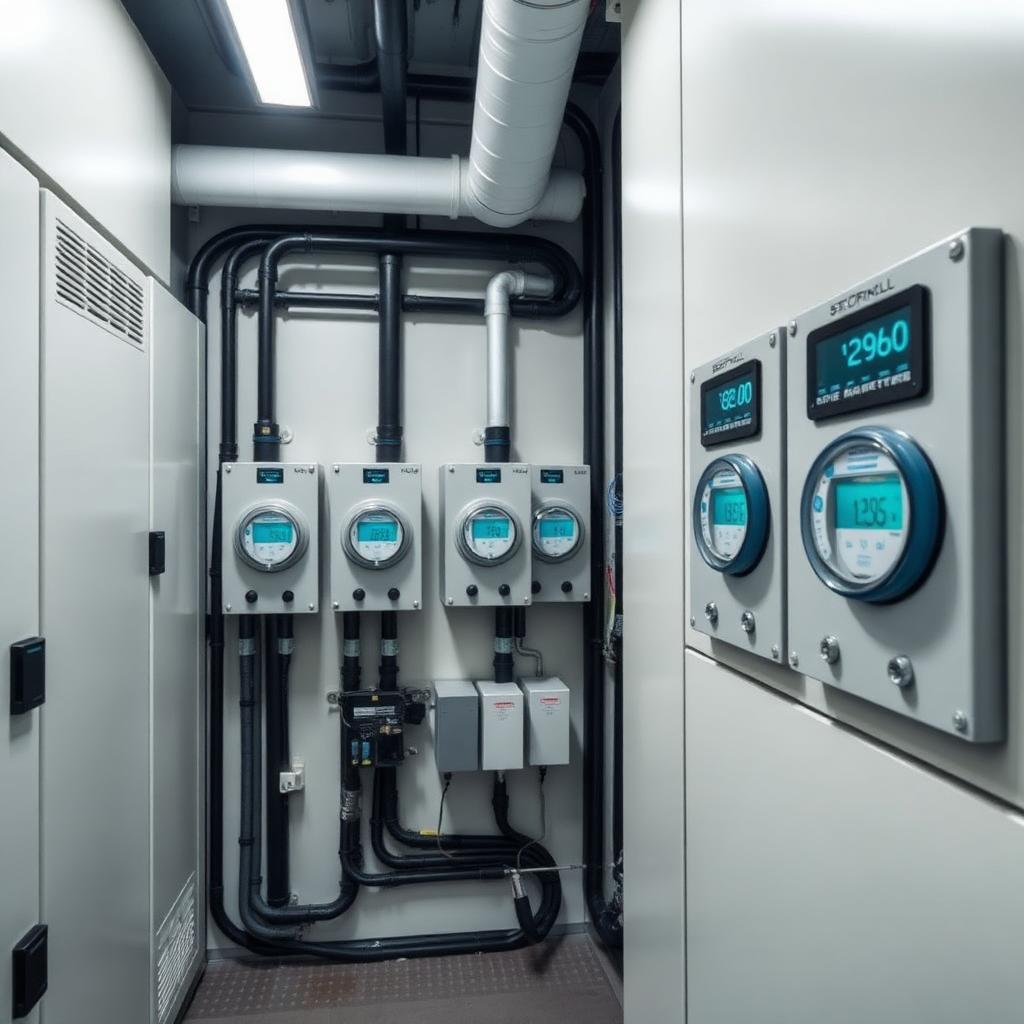
Accurate energy submeter billing starts with billing-grade submeters that meet ANSI C12.20 Class 0.2 accuracy standards. These meters must maintain accuracy within 0.2% to hold up to regulatory scrutiny and tenant audits. Current transformers (CTs) with 0.2 to 0.5% accuracy class clamp around conductors at the panel to sense load without interrupting service, making them well-suited for retrofits in occupied buildings. A single full-panel meter can integrate with up to 42 CTs, giving you circuit-level visibility across a complex tenant space without a full electrical shutdown.
Wireless CT systems use a communications bridge near the panel to collect data from up to 250 CTs, pushing it to the cloud via built-in Ethernet, Wi-Fi, or cellular. An AMI gateway or data concentrator aggregates interval data from all meters and transmits it via Modbus, BACnet, or cellular LTE-M to a cloud billing platform. Without this data pipeline, meter readings stay local and the billing process remains manual. Hardware selection needs to account for panel access, wireless coverage throughout the building, and the total number of tenant loads being metered.
Integrated execution separates a clean deployment from a patchwork one. As part of its submetering setup services, Emergent Energy Solutions manages the full technical stack: site assessment, submeter and CT selection sized to your panel configuration, AMI gateway installation and network setup, commissioning to verify every meter reads within accuracy spec, and API integration into the billing software. Facility managers work with a single point of contact rather than coordinating between separate vendors or troubleshooting a meter installed by one firm and reading into software maintained by another.
Maryland requires PSC approval and 90-day pre-installation notification before any submetering system goes live. New Jersey requires NJBPU approval. Pennsylvania classifies landlords furnishing metered gas to tenants as gas pipeline operators under federal PHMSA rules, which adds registration and reporting obligations; confirm PA-specific pre-approval requirements with the PA PUC, as rules differ from the Maryland and New Jersey frameworks. Navigating that regulatory layer is part of the deployment, not an afterthought.
Calculating accurate tenant invoices from real meter data
For metered tenants, the calculation is straightforward. Divide the total building energy cost by total building kWh to get an average rate, then multiply each tenant's metered kWh by that rate. A tenant consuming 250 kWh at an average rate of $0.30 per kWh owes $75 before tax and applicable fees. That number is tied to a meter reading, not an estimate, and it holds up under tenant scrutiny.
Common areas require a remainder calculation: subtract the sum of all tenant meter readings from the bulk meter reading to get unmetered common area consumption, apply the average rate to cost that remainder, then allocate it pro-rata by square footage. Administrative fees, where legally permitted, are added as a percentage of the allocated cost or a flat monthly charge. Texas caps these fees at 6% of the bill or $4.50 per month. Most regulated jurisdictions require itemized billing statements that show the calculation method, meter readings, and any applied fees. Itemized invoices backed by actual meter data materially reduce the likelihood and scope of billing disputes, since the charge methodology is transparent and tied to a verifiable reading rather than an estimate.
Selecting software and automating monthly invoices
The billing software needs to connect to your AMI gateway via API or scheduled CSV export, generate invoices tied to actual interval meter data, and maintain an auditable ledger for each tenant account. Buildium handles recurring charge automation, delinquency tracking, and property accounting integration, with tiered pricing from $55 to $340 per month. AppFolio suits portfolios above 50 units, with data analytics and integration across leasing, maintenance, and accounting workflows. Yardi Voyager scales further for complex, compliance-heavy enterprise portfolios.
The integration between your AMI gateway and billing platform typically runs through a middleware layer. The AMI gateway exports interval data via CSV or webhook; a middleware service normalizes that data into billable monthly kWh totals and calculates charges using your rate tables, then pushes a charge creation request to AppFolio's Database API or Buildium's Residential API. AppFolio API access requires a Plus or Max plan. That middleware step is what most facility teams underestimate: converting raw meter readings into accurate line items on a tenant invoice is where a solid tenant energy billing setup either holds together or breaks down.
The billing platform comes fully configured as part of the Emergent Energy Solutions engagement: invoice templates tied to actual meter data, rate table setup, and a tenant-facing portal where occupants can view their own consumption in real time. That transparency layer reduces billing disputes before they start, builds tenant confidence in the new system, and creates a documented consumption history that satisfies regulatory inquiries and ESG reporting requirements. Tenants who can see their own usage data are also more likely to modify consumption behavior, which accelerates the overall energy reduction the building sees post-implementation.
Legal disclosure and tenant communication before going live
Switching tenants from all-inclusive rent or square-footage billing to metered billing requires advance written notice, and the required lead time varies by jurisdiction. Arizona requires 90 days written notice for existing tenants. Oregon requires 60 days for month-to-month tenancies. Illinois requires written disclosure identifying common areas and estimated heating costs from the prior 12 months. Most jurisdictions require the billing method to be explicitly defined in the lease before signing, and in Virginia, changes to utility billing typically require a signed lease addendum rather than a unilateral landlord notice.
Landlords who skip documentation, adequate notice, or state utility commission registration before going live expose themselves to tenant challenges and regulatory enforcement. Legal defense costs for billing disputes frequently exceed $25,000 per case. Getting the notification and disclosure process right before launch is not a formality; it is direct risk management.
Communicate the change as a fairness upgrade, not a cost increase. Prepare a one-page summary that explains what changed, how invoices are calculated, and how tenants access their usage data through the portal. A 60-day soft-launch period, where invoices are informational only, gives tenants time to understand their consumption patterns before billing begins in earnest. This approach reduces resistance, makes the legal transition cleaner, and positions the new billing system as a tenant service rather than a landlord revenue extraction tool.
The bottom line on tenant energy billing implementation
A properly executed tenant energy billing setup is not just a billing exercise. It is a cost recovery, compliance, and asset value initiative. Buildings that bill on metered data recover more utility costs, produce the interval data needed for ESG and carbon reporting, and see meaningful consumption reductions from tenant behavioral change. The technology is mature, the formulas are clear, and the legal framework, while variable by state, is navigable with a sound compliance plan.
The real challenge is execution: sourcing the right hardware, commissioning the submetering setup correctly, integrating it with billing software, registering with the relevant state authorities, and managing the tenant communication process without disrupting occupancy relationships. Emergent Energy Solutions handles that entire execution chain as a single integrated engagement, from submeter installation and state commission registration through billing platform configuration and automated monthly invoicing.
If your portfolio is still allocating utility costs by square footage, the gap between what you are recovering and what you are actually owed is worth calculating. Start there, and once you run the numbers, the financial case for switching becomes self-evident. Contact Emergent Energy Solutions to begin with a site assessment and recovery estimate.